Speculative & Ethical Perspectives /
How Do We Navigate the Moral Landscape of Emerging Technologies?
As digital technologies increasingly influence civic life, the field of human-computer interaction (HCI) has rightly focused more on ethical responsibility and wise governance. Whereas HCI was once centered on models of cognition and usability testing, practitioner perspectives now thoughtfully address wider issues of social justice, economic equity and political liberty. Back in the 1990s, forward-thinking scholar Helen Nissenbaum raised concerns about early online networks bypassing norms of privacy and consent. This foreshadowed today's AI-driven landscape challenging existing ethical frameworks. Current scholars like Jack Balkin debate how to ground basic rights constitutionally in a digital era. Researchers like Ruha Benjamin examine how embedded biases can perpetuate injustice through automated systems. This expanded moral conscience calls technologists to approach innovation through a compassionate lens encompassing community values and the greater good. HCI researchers have responded with structural models like Value Sensitive Design that embed ethical deliberation throughout the process, not just assessing end products. As HCI continues to expand in scope and influence, sustaining human progress greatly relies on a commitment to the just, equitable and liberating possibilities of emerging technologies still in development. With ethical governance and moral leadership, technology futures can be shaped to uplift our shared humanity.

Diffusion of Innovations
Everett M. Rogers · 01/01/1962
"Diffusion of Innovations" by E.M. Rogers, examines the mechanisms through which new technologies gain acceptance and diffusion in societies. Though originally not formulated for HCI, this seminal work has profound implications for understanding user adoption and engagement with interactive systems.
- Innovation Attributes: Rogers identifies five key attributes that influence the rate of adoption: relative advantage, compatibility, complexity, trialability, and observability. For HCI, these offer a framework for designing interfaces and experiences that encourage user adoption
- Social Systems: The theory incorporates the role of social systems, communication channels, and opinion leaders, highlighting that the acceptance of a new technology isn't solely an individual decision but influenced by social factors.
- Adoption Lifecycle: Rogers' model of early adopters, early majority, late majority, and laggards serves as a roadmap for phased roll-outs and targeted UX improvements.
- Change Agents: The theory stresses the role of change agents in speeding up the diffusion process. In HCI, these could be usability experts or design teams who can act as evangelists for the user experience.
Impact and Limitations: Rogers’ framework has been instrumental in shaping HCI strategies focused on maximizing user adoption and long-term engagement. However, the model could benefit from integration with more contemporary theories about technology habituation and rejection, to better account for the dynamic nature of user interaction over time.
Read more
In the Age of the Smart Machine: The Future of Work and Power
Shoshana Zuboff · 01/10/1989
This resource revolutionizes the understanding of interactions between humans and computers in the workplace. Zuboff provides a pioneering study of technology's impact on workplace structures and power dynamics.
- Informate vs Automate: Automation replaces human roles, while "informating" provides individuals with data, transforming their roles and decision-making processes. This concept impacts job design and training.
- Abstract vs Physical Labor: The shift from physical to abstract (digital) labor profoundly transforms the nature of work, introducing opportunities for increased creativity and cognitive involvement.
- Power Structures: Technology's influence on workplace hierarchies is significant, potentially equalizing power or increasing managerial control depending on its use.
Impact and Limitations: Zuboff's work remains a cornerstone for HCI, emphasizing a relationship beyond usability, extending to sociocultural interactions. Despite this, her analysis mostly considers deskilled workers; focusing on various job types could provide a more nuanced understanding.
Read more
Technopoly: The Surrender of Culture to Technology
Neil Postman · 01/01/1993
"Technopoly: The Surrender of Culture to Technology" by Neil Postman is a seminal work that delves into the societal and cultural changes brought about by technology. Not strictly an HCI resource, this book has far-reaching implications for those interested in the human side of technology, scrutinizing the unexamined costs of technological advancement.
- Technopoly: Postman coins the term to describe a society where technology is deified and the cultural, social, and even moral fabric is dictated by technological imperatives. This challenges HCI practitioners to consider the ethical dimensions of design.
- Cultural Critique: Postman argues that in a technopoly, technology erases social frameworks and imposes its own. This serves as a cautionary tale for interface designers to be wary of the unintended societal implications of their creations.
- Loss of Narrative: In a technopoly, the cultural narratives that help define human values and purpose are overridden by technology’s own narratives, which are often efficiency-driven. This is an invitation for designers to restore narrative and meaning in human-technology interactions.
- Critical Thinking: The book calls for more critical, reflective interactions with technology, urging an approach that questions rather than passively accepts technological determinism.
Impact and Limitations: Though not written as an HCI text, "Technopoly" forces those in the technology and HCI fields to grapple with the wider consequences of their work. However, its critiques are broad and may not provide concrete design guidelines, inviting further exploration and research in applying its theories to practical HCI issues.
Read more

Weapons of Math Destruction: How Big Data Increases Inequality and Threatens Democracy
Cathy O'Neil · 01/09/2016
This book delves into the ethical and social implications of algorithmic systems in modern society. Cathy O'Neil argues that these so-called "Weapons of Math Destruction" exacerbate social inequalities and pose threats to democracy. The work is seminal in highlighting the unintended consequences of relying on big data and algorithms.
- Algorithmic Bias: O'Neil demonstrates that algorithms, thought to be impartial, often encapsulate existing societal biases. For HCI practitioners, it underscores the need to critically evaluate data sets and algorithmic decision-making processes.
- Opacity and Accountability: The book critiques the lack of transparency in how these algorithms work, making it nearly impossible to challenge or understand them. This raises questions about accountability in HCI design, particularly for systems with far-reaching societal impacts.
- Ethical HCI: The book urges HCI researchers and practitioners to consider the ethical dimensions of technology design, particularly when the scale of impact is large and affects vulnerable populations.
- Social Stratification: Algorithms can reinforce existing social hierarchies by sorting people into categories that determine their opportunities. HCI professionals must consider the societal structures their products might inadvertently support.
Impact and Limitations: The book has been instrumental in promoting ethical considerations in HCI and technology development. It serves as a cautionary tale for practitioners about the unintended consequences of algorithmic systems. However, it could benefit from offering more concrete solutions for how to create more equitable algorithms. Further research is needed in the HCI community to address these challenges, perhaps through a multidisciplinary approach involving ethicists, sociologists, and computer scientists.
Read more
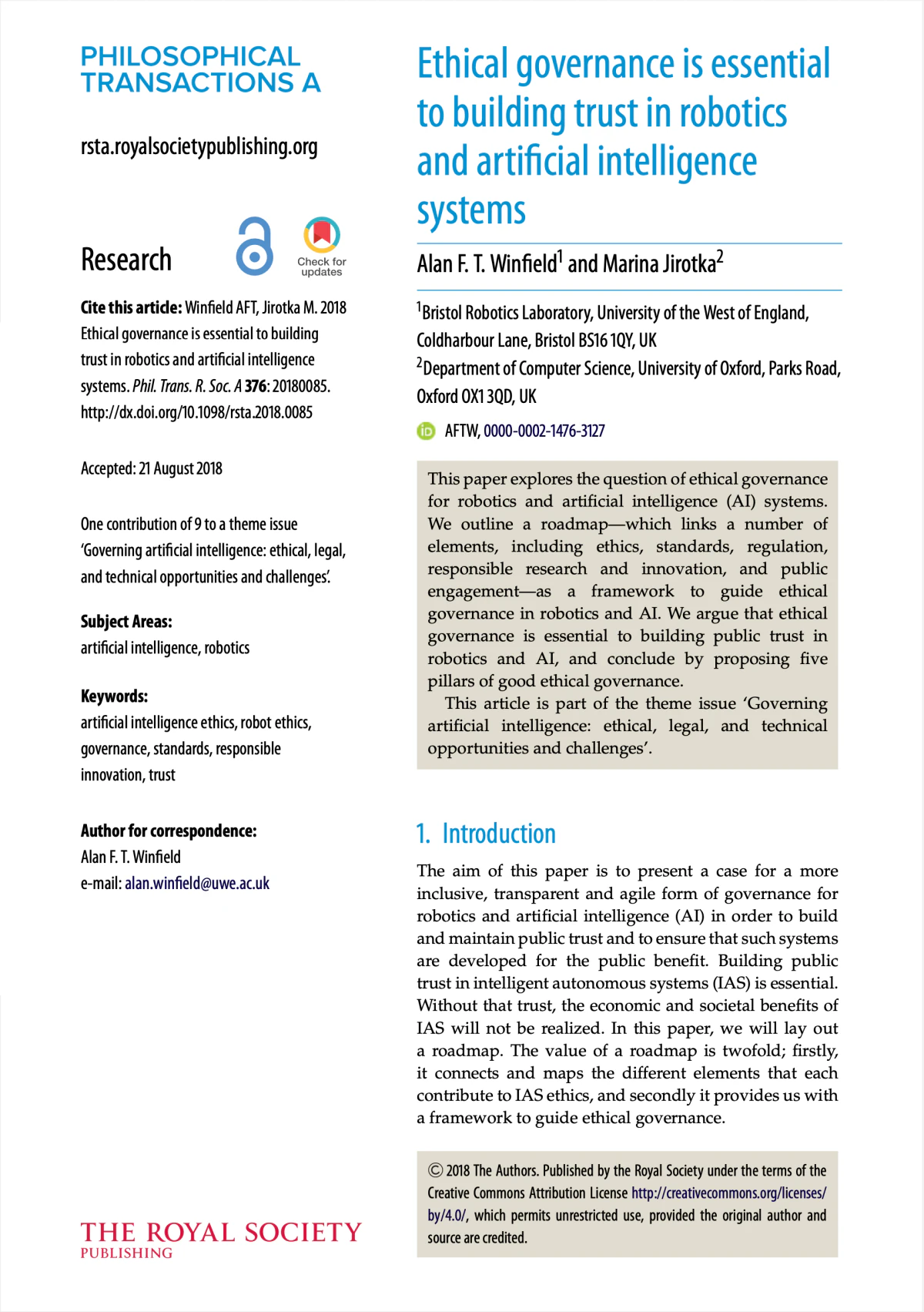
Ethical governance is essential to building trust in robotics and artificial intelligence systems
Alan F. T. Winfield, Marina Jirotka · 01/10/2018
This paper concludes that the incorporation of ethical governance in the design and deployment of robotics and AI is essential to establish trust among users and society. The authors suggest that this approach would also mitigate the potential adverse effects of misuse and accidental harm.
- Ethical Governance: Derives from ethical principles such as transparency, accountability, and inclusivity that are to be embedded in robotic and AI systems. It requires consideration through the entire lifecycle of these systems.
- Building Trust: Trust is fundamental for successful interaction between humans and AI/robotic systems. Ethical governance can foster this trust by providing behavioural assurance.
- Mitigating Misuse and Accidental Harm: The authors argue that ethical governance can reduce misuse through user authentication measures and by designing systems that adhere to safety guidelines, limiting potential harm.
- Principles to Practice: Transitioning from ethical principles to practical implementation remains a challenge and needs more nuanced research and industrial commitment.
Impact and Limitations: The principles identified in this paper can significantly influence the design and deployment of AI/robotic systems. However, the paper does not provide a systematic method that can be practically implemented. Future research should focus on offering a comprehensive framework to transition these principles into practice.
Read more
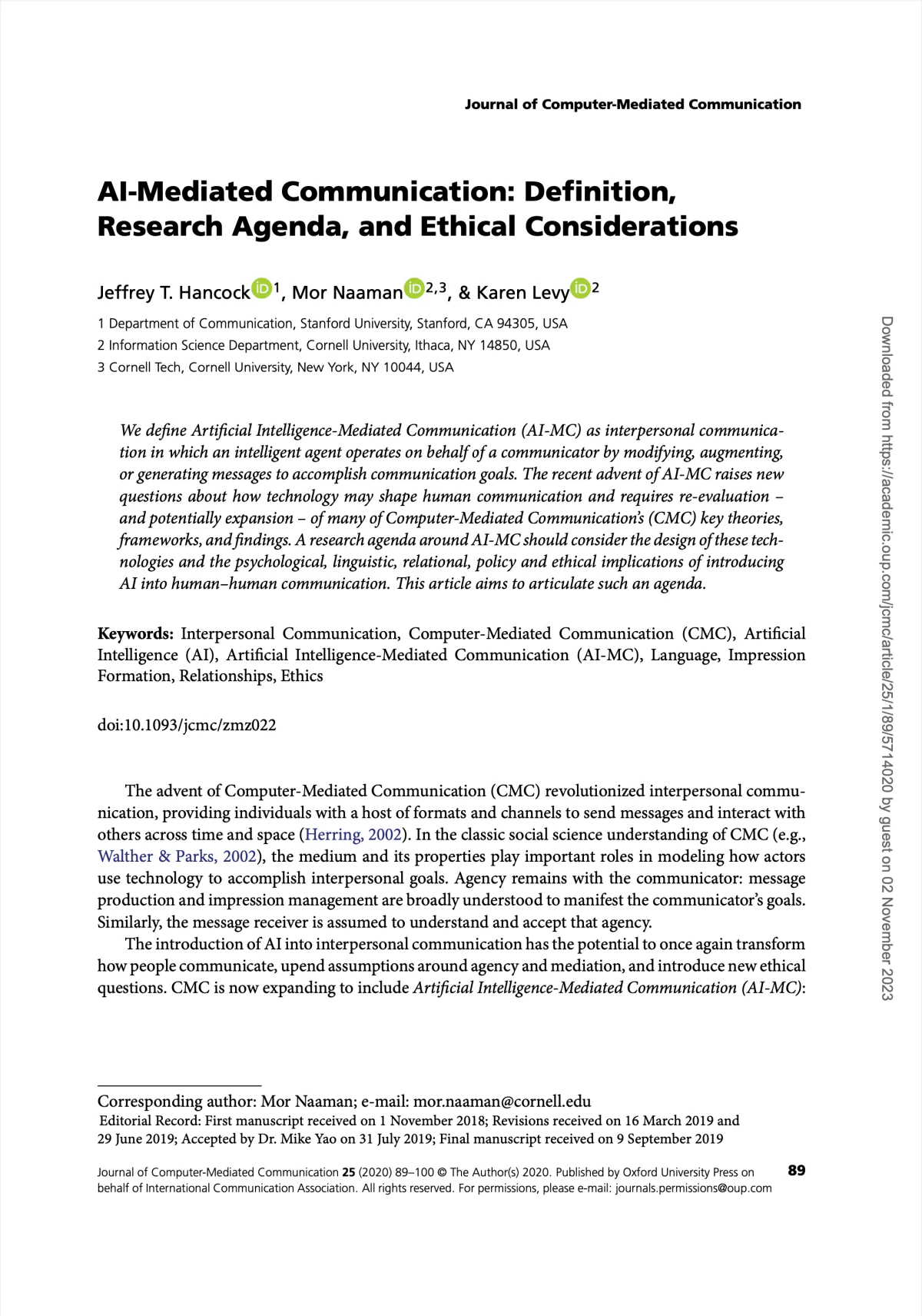
AI-Mediated Communication: Definition, Research Agenda, and Ethical Considerations
Jeffrey T. Hancock, Mor Naaman, Karen Levy · 01/01/2020
This paper fundamentally discusses AI-Mediated Communication (AI-MC), an emerging facet that integrates artificial intelligence within human interaction. It serves as a pivotal roadmap for HCI practitioners and researchers in this burgeoning area.
- AI-Mediated Communication: AI-MC characterizes any communication context in which AI agents actively participate and modify human interaction. It includes voice assistants, chatbots, and AI-based recommendation systems.
- Communication Affordances: The paper identifies four affordances of AI-MC: productivity, augmentation, substitution, and delegation. These dimensionalize potential enhancements and replacements offered by AI in communication settings.
- AI-MC Research Agenda: The authors provide a comprehensive research framework for investigating AI-MC, addressing fundamental questions such as determining appropriate identity for AI agents and understanding the effects of AI-MC on human behavior.
- Ethical Considerations: It underlines key ethical considerations including perception management, privacy, accountability, and bias, signaling the importance of ethical design and deployment of AI-MC.
Impact and Limitations: The paper's landscape analysis and research agenda guidance shape the nascent field of AI-MC, potentially informing AI-related research, design, and policy decisions. It is, however, limited by the rapid advances in AI, requiring constant revisiting and revision of its observations and recommendations.
Read more
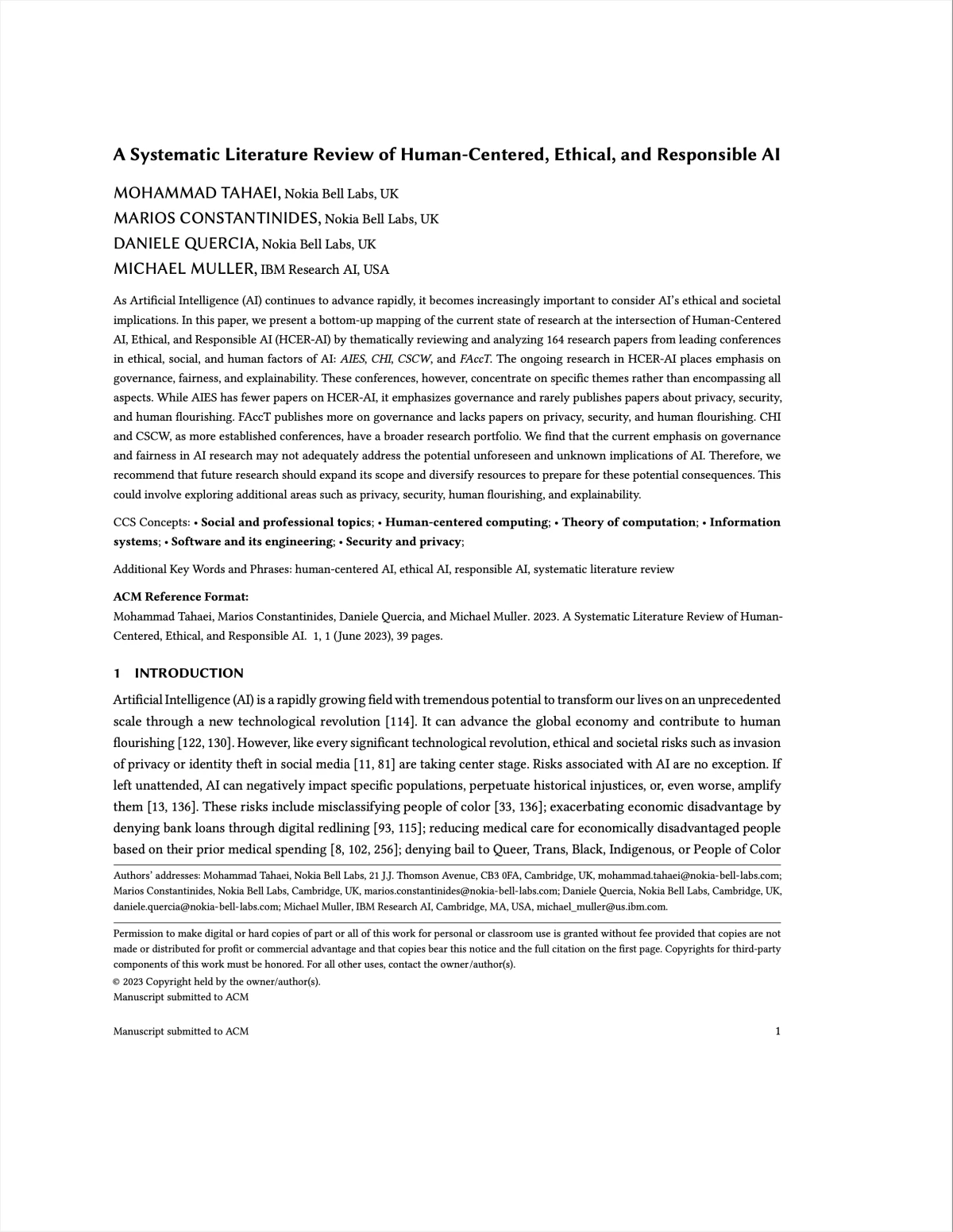
A Systematic Literature Review of Human-Centered, Ethical, and Responsible AI
Mohammad Tahaei, Marios Constantinides, Daniele Quercia, Michael Muller · 01/06/2023
This paper offers a comprehensive overview of Human-Centered Intelligent Systems (HCIS), discussing concepts related to ethical and responsible artificial intelligence (AI). It provides a pioneering look into the integration of HCI with ethical considerations.
- Human-Centered Design (HCD): Emphasizes the importance of involving users at every stage of the design process to ensure AI systems are user-friendly and foster positive user experiences.
- Ethical AI: Underlines the necessity of embedding ethical considerations in AI systems to preserve human dignity, autonomy, and to ensure fairness and transparency.
- Responsible AI: The responsibility in AI system deployment is underscored, highlighting the importance of understanding and mitigating potential risks and harms.
- Algorithmic Accountability: The paper underscores the importance of accountable AI systems which should reliably behave as intended, with mechanisms to detect and correct erroneous behaviour.
Impact and Limitations: The paper provokes critical thought on the integration of HCI with ethics in AI, redefining how technology should be designed, used and governed. However, the challenges of coordinating multi-disciplinary teams and the dynamic nature of ethical principles warrant further investigation. Future research might explore the development of real-world applications that embody these principles.
Read more