Evolution /
Why Did HCI Embrace the Cognitive Perspective?
The pivotal "cognitive turn" in HCI emerged in the 1980s when designers realized the necessity of aligning technology to the human mind's inner workings. This shift celebrated a renaissance towards interfaces and systems that mirrored users' mental models rather than solely focus on functionality. Seminal figures like Donald Norman explored cognitive psychology perspectives, conceiving new principles for design centered around naturalness, visibility, mapping, consistency and constraints. Researchers built cognitive models to simulate and predict human perceptual and problem-solving behaviors during interactions. The deepening insight into mental processes fueled continual innovation in interaction approaches. As the cognitive view permeated the field, it edged HCI closer toward the visionary goal of creating experiences feeling like extensions of ourselves—intuitive, seamless, and human. It transformed static tools into adaptive partners by unlocking design that resonates with our innate cognitive abilities and proclivities. Understanding the profound interplay between mind and machine remains an ongoing quest at the heart of HCI.
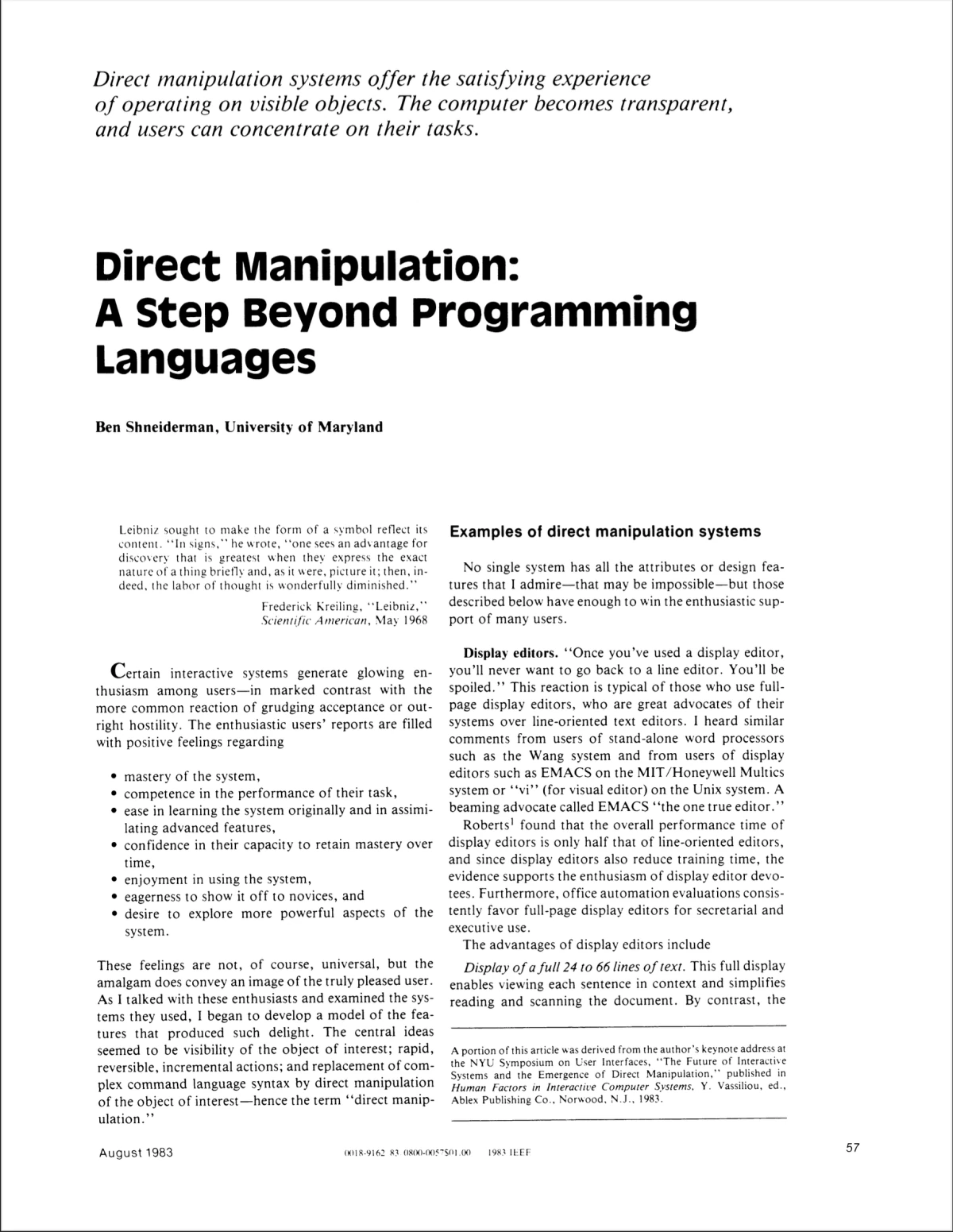
Direct Manipulation: A Step Beyond Programming Languages
Ben Shneiderman · 01/08/1983
Published in 1983, Ben Shneiderman's paper stands as a cornerstone in the realm of HCI by introducing the concept of direct manipulation. The paper challenges traditional programming languages and argues for interfaces that enable users to directly manipulate objects presented to them, reducing the cognitive load and making computing more intuitive.
- Direct Manipulation: Shneiderman advocates for interfaces that allow users to directly interact with on-screen objects, rather than indirect methods like command-line inputs. This principle is foundational for the design of graphical user interfaces (GUIs).
- Cognitive Load: Direct manipulation aims to reduce cognitive burden by making interactions more natural and predictable. This is highly relevant for designers aiming to simplify complex processes in a user-friendly manner.
- User Feedback: The paper emphasizes the importance of real-time feedback for user actions, a staple in modern UI design. Providing immediate feedback helps users understand the system's state and adjust their actions accordingly.
- Learnability: Shneiderman argues that direct manipulation interfaces are more learnable than their programming language counterparts. This underlines the importance of discoverability in modern interface design.
Impact and Limitations: This work catalyzed the development of more intuitive, user-friendly interfaces and has broad applications in software design, from desktop applications to mobile apps. However, it's worth noting that direct manipulation is not universally applicable, such as in cases requiring abstract problem-solving or expert systems. Continued exploration in these areas would provide a more comprehensive application of direct manipulation principles.
Read more
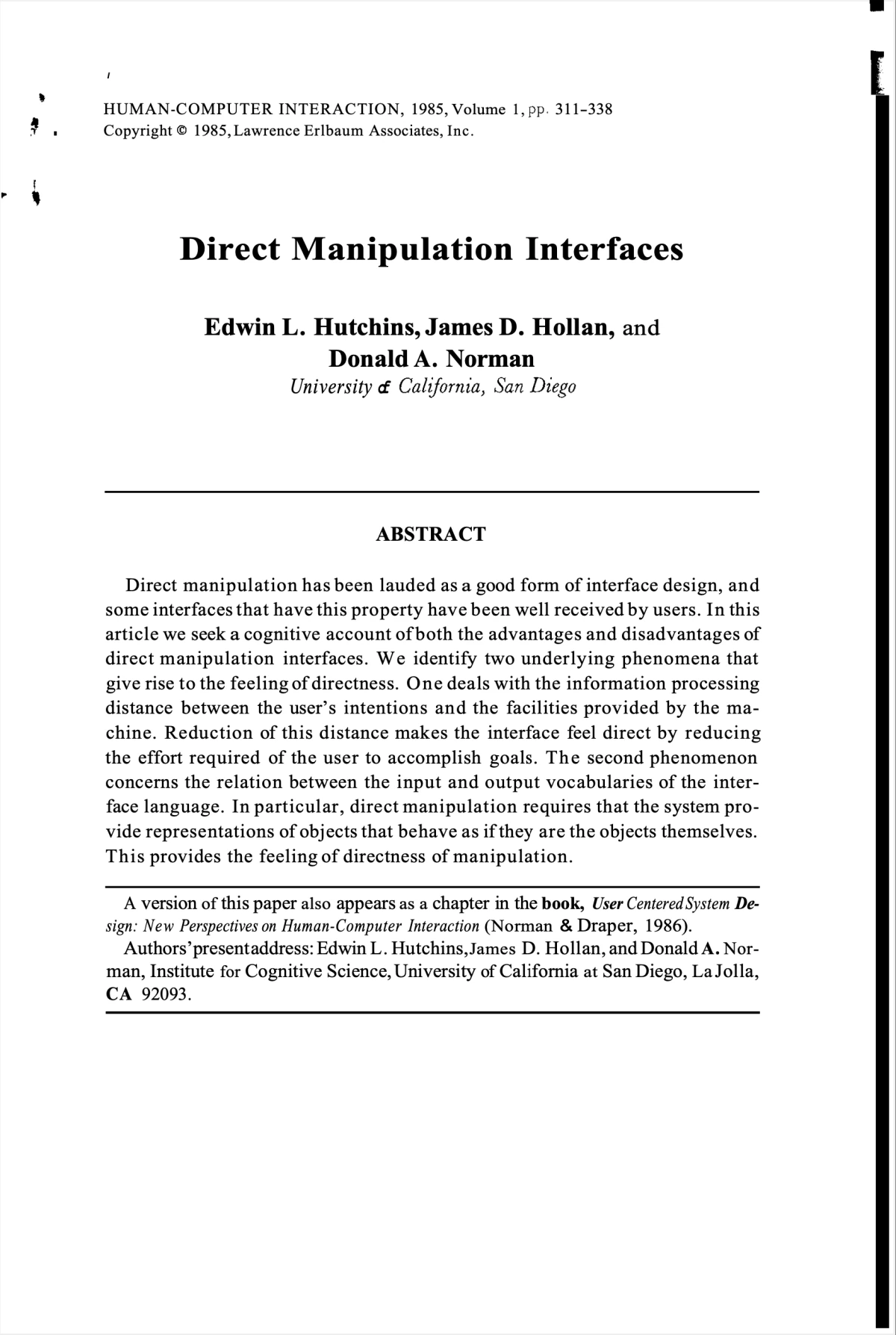
Direct Manipulation Interfaces
Edwin L. Hutchins, James D. Hollan, Donald A. Norman · 01/12/1985
This seminal paper introduced Direct Manipulation Interfaces (DMIs), a game-changing concept in HCI that emphasized the user’s involvement and control in the interaction process. This offered an intuitive, visual, and efficient way to interact with digital systems.
- Directness and Visibility of Actions: The paper positions DMIs as affording immediate visibility of actions, with reversible operations and rapid, incremental feedback. This enhances users' sense of control and reduces cognitive load.
- Intuitiveness and Naturalness: The authors argue that DMIs provide an intuitively natural user experience by mimicking physical world interactions, thus lowering learning curves for new users.
- Engagement and Efficiency: Another core feature is the high level of user engagement and task efficiency DMIs offer, by allowing users to concentrate on their tasks rather than the underlying computational processes.
Impact and Limitations: DMIs marked a paradigm shift in HCI, paving the way for technologies like touchscreen devices and gestural interfaces. Its visual, tactile, and intuitive qualities are now deemed vital for effective interfaces. Still, the concept could be stretched further by exploring multi-sensory DMIs, exploring sound, haptic feedback or body movements to create more immersive and natural interactions.
Read more
Plans and Situated Actions: The Problem of Human-Machine Communication
Lucille Alice Suchman · 01/02/1987
Lucille Alice Suchman's seminal 1987 book, "Plans and Situated Actions," addresses the limitations of early human-computer interaction (HCI) models that overly relied on formalized plans and scripts. By focusing on situated actions, Suchman's work steers HCI towards a more nuanced understanding of how humans interact with machines in context-sensitive ways.
- Situated Actions: Suchman argues that human behavior isn't purely plan-driven but arises from the situation at hand. This insight has major implications for HCI design, suggesting a need for more adaptive and context-aware systems.
- Ethnographic Approach: The book employs ethnographic methods to observe real-world human-machine interactions, offering empirical grounding to its theoretical framework.
- Human-Machine Symbiosis: Suchman's work challenges the notion of a one-way human-to-machine directive, advocating for a more reciprocal relationship where both adapt to each other's actions.
- Plan-Based Limitations: The book critically assesses the limitations of plan-based models in HCI, recommending a shift towards more flexible and context-sensitive paradigms.
Impact and Limitations: Suchman's work has had a transformative impact on HCI and related fields like artificial intelligence and robotics. It laid the groundwork for later advances in adaptive interfaces and intelligent systems. However, the transition from plan-based to situated models has been complex, and the book doesn't offer a direct path for this transition, leaving room for further research and application.
Read more
Understanding Computers and Cognition: A New Foundation for Design
Terry Winograd, Fernando Flores · 01/09/1987
"Understanding Computers and Cognition: A New Foundation for Design" by Terry Winograd and Fernando Flores is a seminal text that fundamentally challenges conventional thinking in human-computer interaction and artificial intelligence. Rather than following the rationalist tradition in AI, which aims to replicate the human mind, the authors advocate for a hermeneutic approach focused on constructing prostheses to augment human cognition.
- Hermeneutic Approach: Winograd and Flores propose shifting from the rationalist tradition in AI to a hermeneutic framework that emphasizes interpretation and understanding. This challenges the AI community's focus on creating a human-like mind and instead advocates for tools that magnify human cognitive capacities.
- Computers as Language Processors: Within this hermeneutic framework, computers are primarily seen as tools for manipulating symbols and facilitating human language, directing HCI focus toward the linguistic and semiotic aspects of interface design.
- Action-Oriented Design: Building on this new foundation, they introduce an action-oriented perspective where design should focus on enabling specific human actions, thereby opening the door for more context-aware, user-centered systems.
- Breakdowns and Repairs: The authors also introduce the notion of "breakdowns" as moments when a system fails to meet user expectations, and "repairs" as design opportunities. This encourages a dynamic, adaptive approach to HCI.
Impact and Limitations: The work has reoriented the HCI and AI fields toward a deeper, more nuanced understanding of human cognition and language. It has encouraged interdisciplinary dialogue, particularly with philosophy, but may lack specific, actionable guidelines, making it more of a conceptual touchstone than a practical manual for designers. The book also opens the debate on whether AI needs to have a better appreciation of biology and psychology in addition to the hermeneutic approach advocated by the authors.
Read more
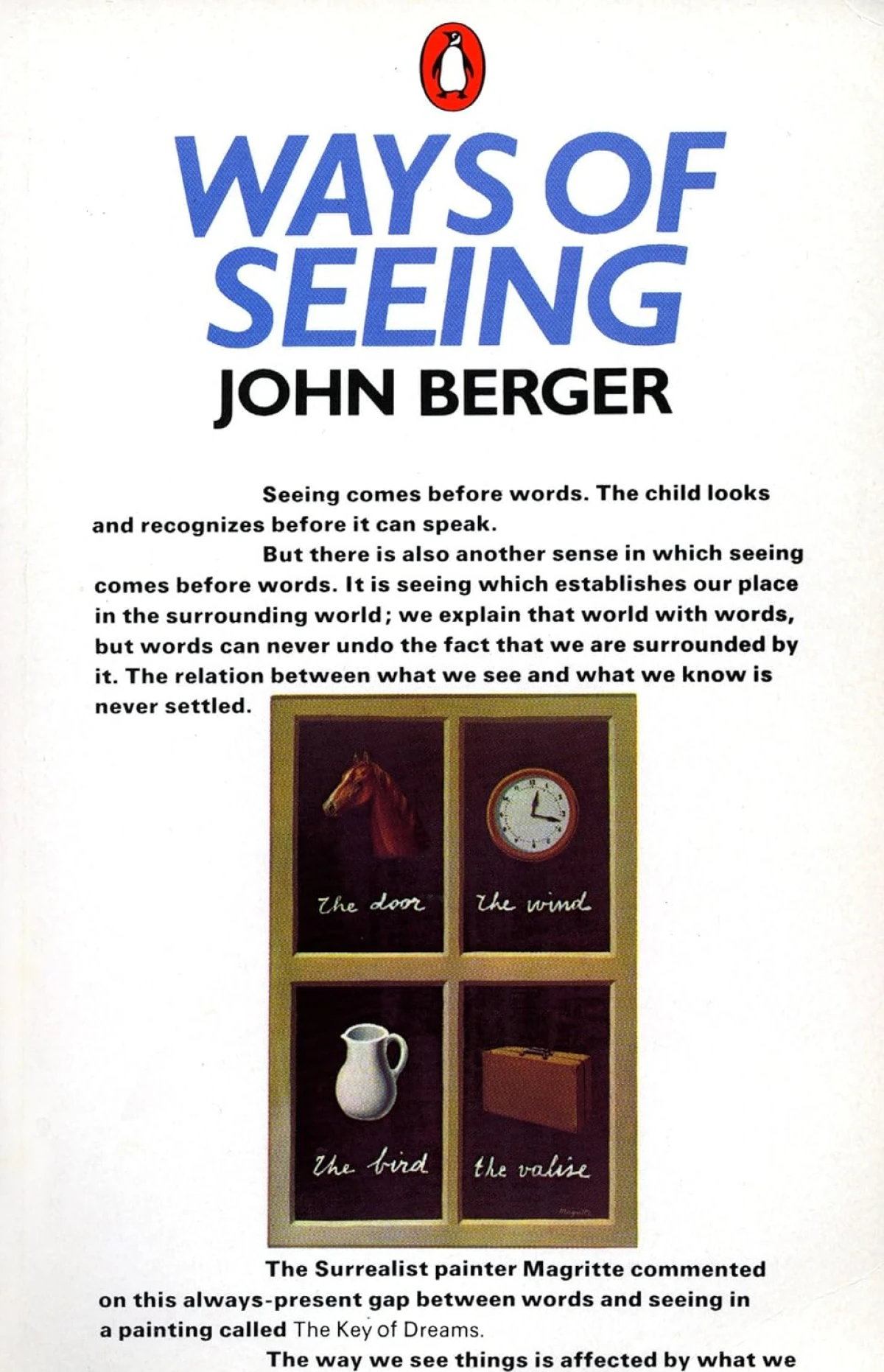
Ways of Seeing
John Berger · 01/01/1972
"Ways of Seeing" by John Berger is a seminal text in the field of art theory that has cascading implications across multiple disciplines, including HCI and design. Originally presented as a BBC series, the book focuses on the interpretation and representation of visual images and how they shape our perception.
Mechanisms of Seeing: Berger argues that seeing is a construct shaped by cultural, historical, and social factors. In HCI, this idea prompts us to consider the socio-cultural elements that influence user interactions with technology.
Context in Interpretation: Berger emphasizes the context in which an image is seen—whether a painting or a UI element—shapes its interpretation. This insight is critical in HCI, where user experience is highly context-dependent.
Power Dynamics: The book also discusses the power relations encoded in visual imagery, a concept that designers can apply when creating interfaces that are inclusive and devoid of unconscious bias.
Medium and Message: Berger examines how the medium affects the perception of the message, an idea that HCI practitioners can adapt to understand how different interface elements shape user behavior and experience.
Impact and Limitations: "Ways of Seeing" has been a cornerstone in studies of visual culture and has impacted design practices in HCI by adding a nuanced layer to the understanding of how visual elements are perceived. However, its primary focus on art and static imagery may limit its direct applicability to dynamic, interactive digital interfaces, suggesting a need for additional research in this direction.
Read more

The Design of Everyday Things
Don Norman · 01/01/1988
Don Norman's "The Design of Everyday Things" is seminal in the field of design and HCI. Originally published in 1988, it tackles the psychology behind how users interact with everyday objects, shifting the focus from user error to poor design. The book is foundational in human-centered design principles.
- Affordances: Norman popularized the concept of "affordances," which are cues on how an object should be used. For practitioners, this highlights the need to make system functions immediately apparent to the user.
- Mapping: This book introduces the principle of mapping, where controls should correspond spatially to their effect. This is vital for HCI practitioners working on interface layouts and control schemes.
- Feedback: Norman emphasizes that systems should provide feedback to indicate the result of an action. This is crucial in designing user interfaces that keep users informed and engaged.
- Constraints: The book outlines how design can limit user actions to prevent errors, guiding designers to incorporate logical, physical, and semantic constraints in their work.
Impact and Limitations: This book has profoundly influenced product design, UX, and HCI, becoming a must-read for practitioners. However, it doesn't provide a comprehensive framework for complex digital systems, which can be viewed as a limitation given the advances in technology since its publication.
Read more
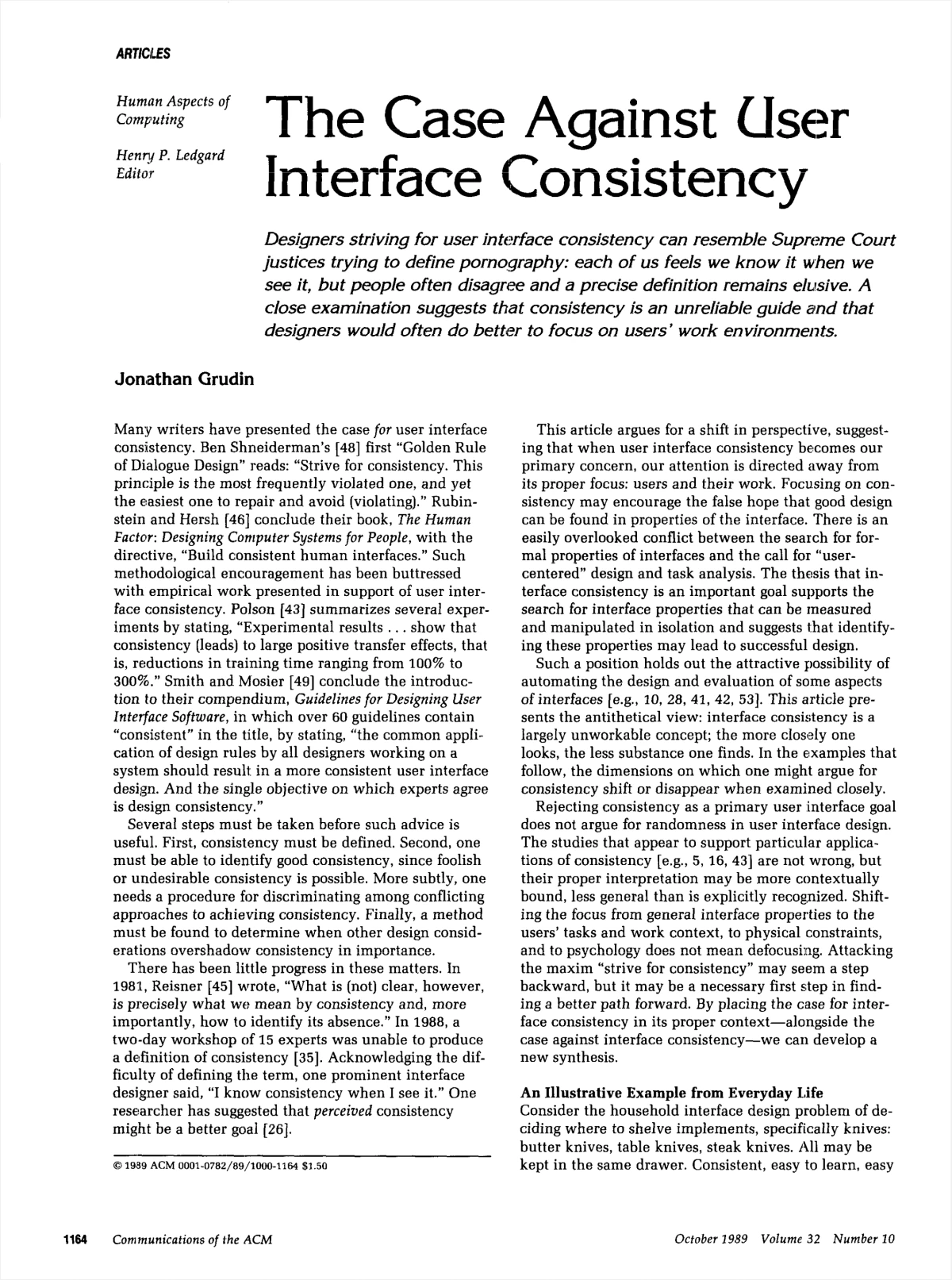
The Case Against User Interface Consistency
Jonathan Grudin · 01/10/1989
The 1989 paper by J. Grudin challenges the then prevalent ideology in HCI that user interface consistency should be pursued at all costs. It offered a bold departure, exploring the nuanced balance between consistency and variability in interface design.
- Consistency-Variability Spectrum: Consistency in design affords benefits like ease of learning and user predictability, but too much of it can limit design creativity and innovation.
- Contextualizing Consistency: Context applies to consistency. The functionality and purpose of software should influence the extent of consistency. A word processing software should differ from a video editing software.
- User’s Experience Level: The user’s experience matters when it comes to consistency. Novice users may benefit more from consistency while experienced users may appreciate interface variability.
- Tradeoffs in Design: Pursuing consistency may necessitate trade-offs like not accommodating unique functionalities. Such trade-offs should be carefully evaluated.
Impact and Limitations: Grudin's perspective urges HCI practitioners to assess the appropriateness of consistency in their design processes, leading to a richer diversity of interfaces in the market, thus, acknowledging unique user contexts and experiences. However, the paper does not provide a concrete framework to determine the optimal balance between consistency and variability, pointing to areas where future research might focus.
Read more
Cognition in the Wild
Edwin Hutchins · 01/01/1996
Edwin Hutchins' "Cognition in the Wild" is a seminal work that bridges anthropology and cognitive science, offering a system-level understanding of cognition. It marks a departure from traditional lab-based cognitive studies, laying new foundations for Human-Computer Interaction (HCI) by emphasizing cognition in real-world settings, particularly in naval navigation.
- Interdisciplinary Approach: Hutchins fuses anthropological methods with cognitive science, providing a richer framework for understanding complex human-system interactions. This can guide HCI practitioners in designing more nuanced, context-sensitive systems.
- Cultural Cognitive Systems: Challenging the notion that culture merely influences individual cognition, Hutchins introduces the concept that cultural systems have their own cognitive properties. This opens the door for HCI designs that consider collective intelligence.
- Real-world Application: By examining naval navigation, Hutchins extends the metaphor of cognition as computation into real-world tasks, breaking from the confines of lab settings. This is crucial for HCI solutions that must operate "in the wild."
- Cognition Scalability: Hutchins explores how cognitive systems adapt and change across scales, from individuals to large teams. This is especially valuable for HCI designs aimed at evolving, large-scale environments.
Impact and Limitations: This work has far-reaching implications for HCI, offering a systemic viewpoint that can guide the design of complex, culturally-informed systems. However, the focus on naval scenarios raises questions about the generalizability of the findings. Future research could adapt this framework to various other domains, examining its applicability and limitations further.
Read more
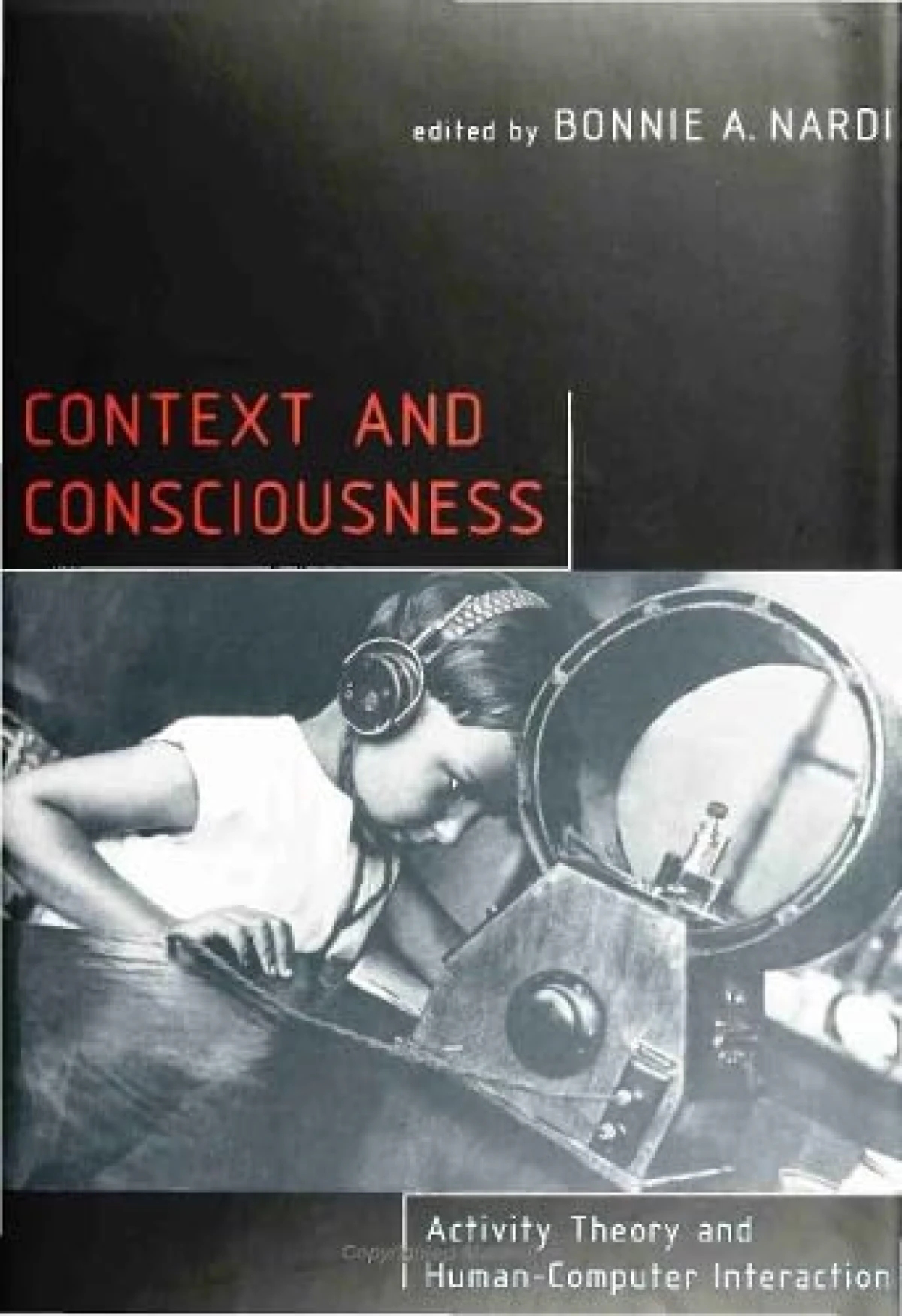
Context and Consciousness: Activity Theory and Human-Computer Interaction
Bonnie A. Nardi · 01/01/1995
"Context and Consciousness: Activity Theory and Human-Computer Interaction" serves as a pivotal resource that applies activity theory to HCI research. This collection of 13 contributions steps out of the lab and into real-world contexts, pushing the boundaries of traditional HCI methodologies.
- Activity Theory Framework: Rooted in Soviet psychological theory, activity theory offers a hierarchical structuring of human activity and practical perspectives. It has been effectively applied in various domains and offers a solid framework for HCI, focusing on how people use technology in everyday life.
- Naturalistic Emphasis: Activity theory encourages field studies and a more naturalistic approach to understanding HCI. This shift allows for richer, contextual data that can guide both practical design and theoretical advancement.
- International Collaboration: The book incorporates work from an international community of researchers, each contributing unique insights into the application of activity theory in HCI. This collective effort enriches the multidisciplinary nature of the field.
- Broad Applications: Activity theory's versatile nature allows for its application in specialized areas such as ergonomics, educational testing, and even healthcare, making it a multifaceted tool for HCI research.
Impact and Limitations: The integration of activity theory into HCI research opens doors for more context-aware, human-centered design and evaluation. However, the theory's broad scope could potentially dilute its effectiveness in addressing specific HCI problems. More research is needed to establish standard methodologies for applying activity theory to HCI.
Read more
Ambiguity as a Resource for Design
William W. Gaver, Jake Beaver, Steve Benford · April 2003
The paper introduces a paradigm shift in the HCI field by advocating the intentional introduction of ambiguity in design as a means to provoke user interpretation and engagement. It significantly contributed to the evolution of user-centred design theory.
- Designing for Ambiguity: The authors propose that ambiguity, seen traditionally as a flaw in design, can stimulate user creativity and engagement. Designs don't have to be clear cut always.
- Three Types of Ambiguity: They categorize ambiguity into ambiguity of information, context, and relationship. Different types require different designs strategies and have unique user responses.
- Conceptual Framework: The authors present a conceptual framework for designing with ambiguity, bridging theory and practice. This guides designers to consider ambiguity during the design process.
- Examples and Case Studies: The paper provides real-world examples and case studies, making the concept tangible and applicable for practitioners.
Impact and Limitations: The paper revolutionized HCI and design philosophy by validating ambiguity as a tool for engagement. As an example, Apple’s minimalist design often leaves room for user interpretation. However, the appreciation for ambiguity can greatly vary among users, which could limit its effectiveness. Future research could focus on identifying different user typologies in response to ambiguity.
Read more