Evolution /
How Have Interaction Paradigms Evolved in HCI?
In HCI's early days, pioneers like Vannevar Bush and J.C.R. Licklider established a focus on optimizing human-machine collaboration by envisioning computers as amplifiers of human intellect. Bush conceived the Memex machine in 1945 as an augmenter of memory, while Licklider prescribed man-computer symbiosis in 1960. This era, spanning the 1960s and 1970s, involved quantifying human performance in system interaction through empirical studies and models examining behavior, decision-making and memory. Seminal figures like Stuart Card and Thomas Moran at Xerox PARC influenced generations by determining design principles based on response times and user frustration. Other pioneers include Douglas Engelbart, whose 1968 “Mother of All Demos” demonstrated revolutionary technologies like video conferencing, the mouse and hypertext decades ahead of their time. As personal computing spread through the 1980s and 1990s, the field vastly expanded. Emerging subfields like computer-supported collaborative learning explored new directions for empowering humans through technology design. As computing power and AI advance, the HCI lens remains essential for shaping how technology amplifies rather than replaces human capabilities.
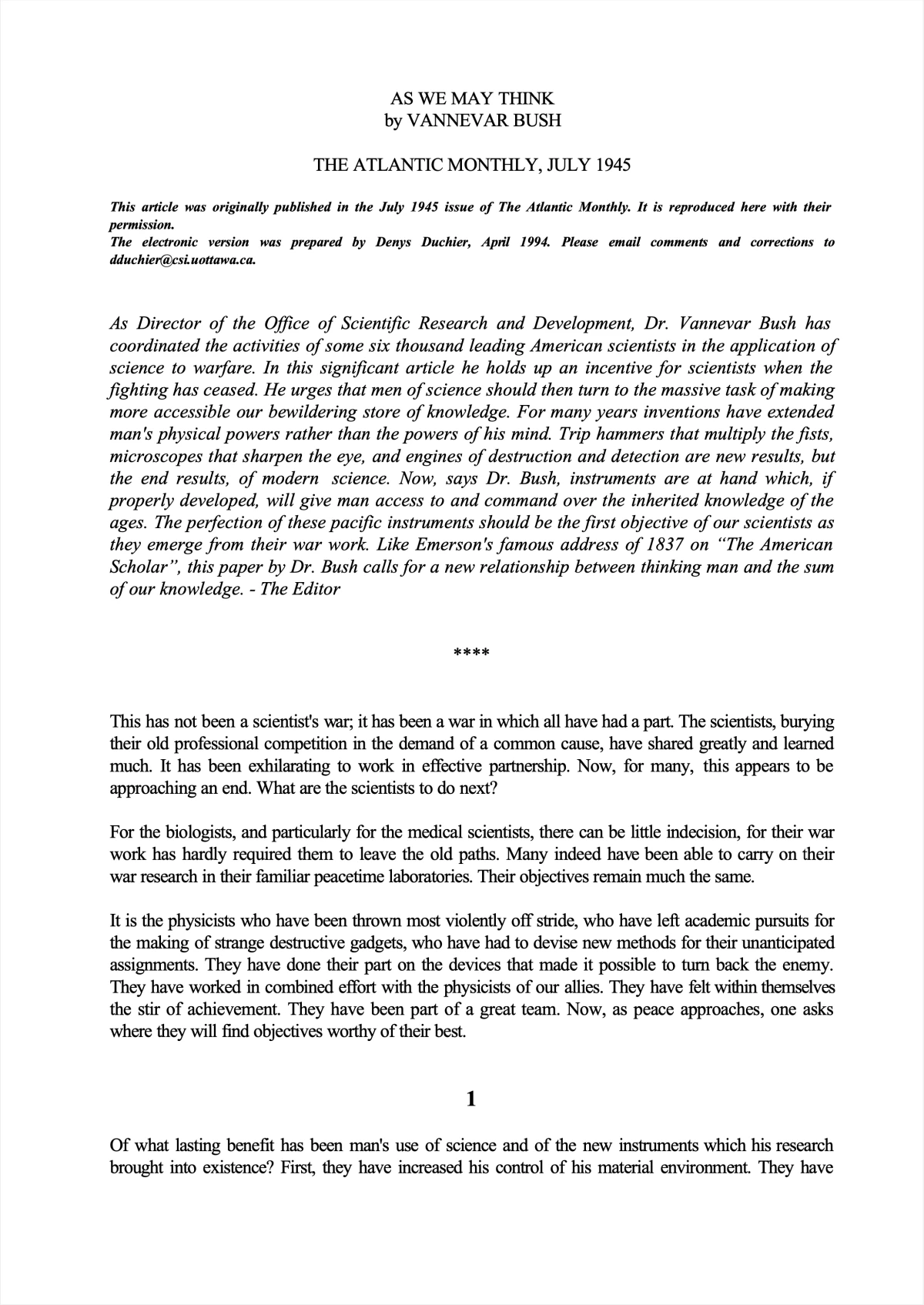
As We May Think
Vannevar Bush · 01/07/1945
"As We May Think" by Vannevar Bush is a seminal publication that revolutionized the field of Human Computer Interaction(HCI) by envisioning the concept of the "Memex” machine. This text has essentially laid the foundation of modern information technology and internet.
- Memex Concept: The concept of the Memex, a device for individual use, to store, cross-reference, and retrieve information, was groundbreaking and remains a cardinal principle in HCI design.
- Information Retrieval: Bush's ideas about information retrieval and hyperlinking have led to today’s browsing and search mechanisms, providing fundamental functionality in information spaces.
- User-expertise spectrum: The Memex was designed to cater to novice and expert users alike, which influenced the concept of user personas and inclusive HCI design.
Impact and Limitations: Bush's vision has had a profound influence on HCI and the technology used today. His theory on information retrieval resulted in practical aspects like web browsing. However, concepts presented are not universal solutions. Future research could explore ways of further enhancing accessibility and inclusion in HCI design.
Read more
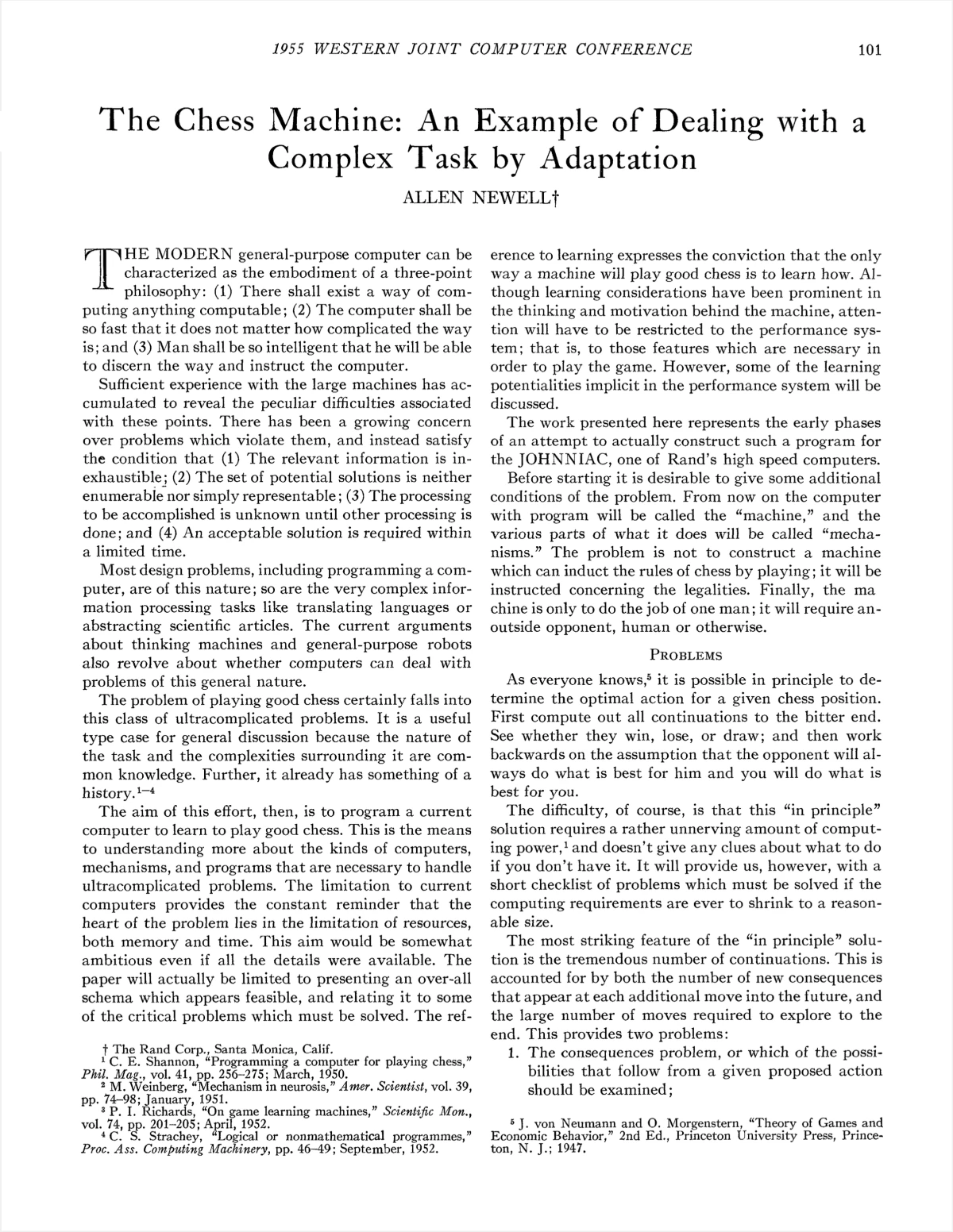
The Chess Machine: An Example of Dealing With a Complex Task by Adaptation
Allen Newell · 01/03/1955
The seminal work of Newell in 1955 shifted the landscape of Human-Computer Interaction (HCI) by introducing “The Chess Machine,” a model adapting computer operations for a complex gameplay task.
- Adaptation in HCI: Newell's work showcased how computers could adapt to suit complex human tasks like chess, establishing a foundation for future adaptive interfaces.
- Chess as HCI Benchmark: By choosing chess—an intellectually demanding game—Newell offered a groundbreaking standard for evaluating HCI and AI systems.
- Performance Modeling: Newell introduced a method of analyzing the efficiency of computer adaptations, thus pioneering the area of HCI performance modeling.
Impact and Limitations: Newell's work marked a paradigm shift in HCI, emphasizing adaptation and performance evaluation for complex tasks. Though revolutionary, it was limited to a single game-matrix, chess, hinting at the necessity for holistic research in diverse real-world contexts. Future research should explore how to apply Newell's insights to a wider array of domains and user experiences to truly harness the potential of adaptation in HCI.
Read more
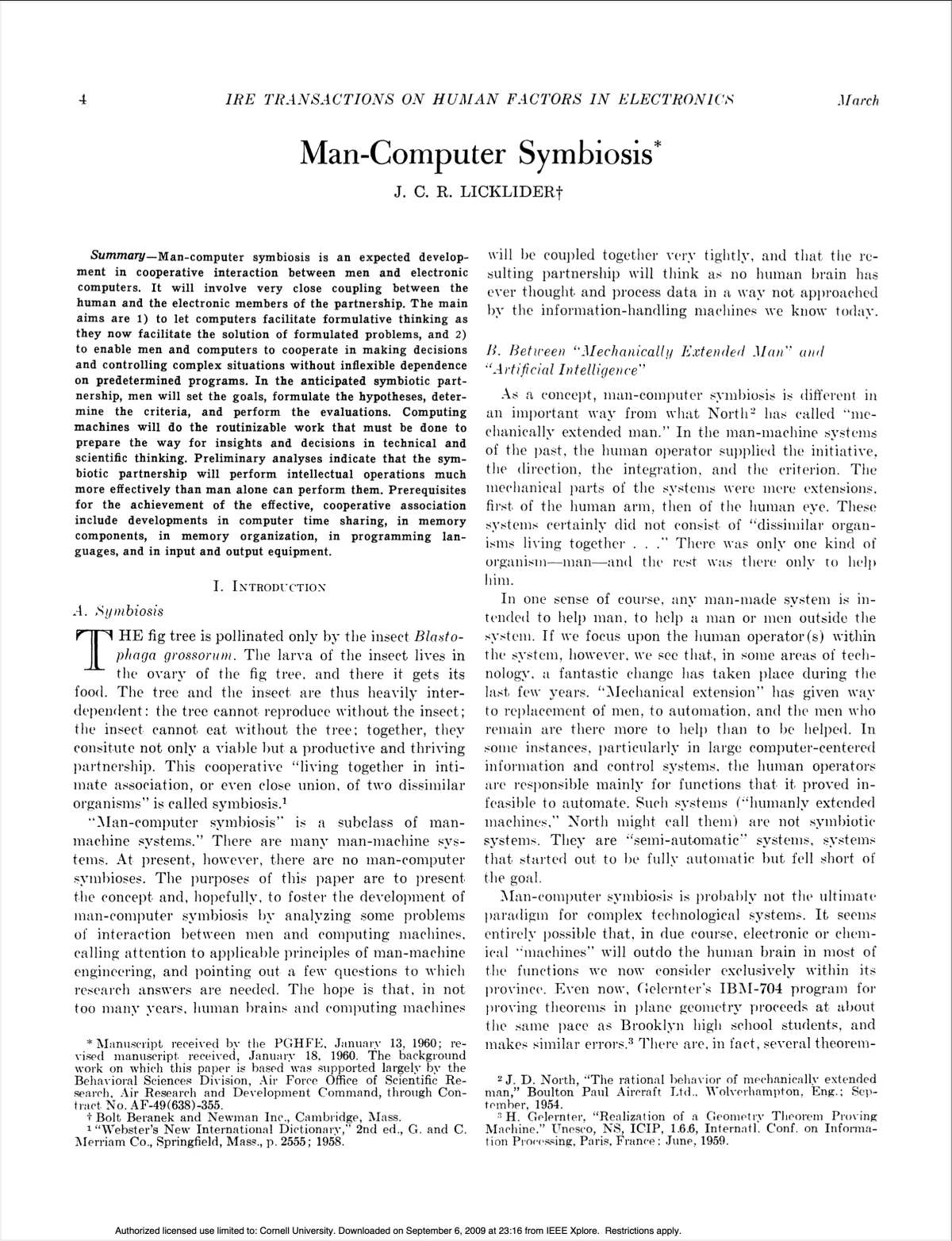
Man-Computer Symbiosis
J.C.R Licklider · 01/03/1960
This seminal paper by J.C.R. Licklider presents the foundational idea of a symbiotic relationship between humans and computers, advocating for collaborative interaction to leverage the strengths of both. Published in 1960, the paper sets the stage for the evolution of HCI and user-centered design.
- Symbiotic Relationship: Licklider posits that humans and computers can augment each other's capabilities. For practitioners, this translates to designing systems where tasks are divided based on the strengths of humans and computers, optimizing performance.
- Real-time Interaction: The paper emphasizes the necessity of real-time interaction for effective collaboration between man and machine. This is crucial for modern HCI where immediacy in feedback and action is expected.
- Natural Language Processing: Licklider advocates for systems capable of understanding natural language to facilitate easier interaction. Today, this manifests in voice-activated systems and chatbots.
- Goal-Oriented Design: The paper outlines the importance of building systems designed to accomplish specific tasks, as opposed to general-purpose computing. This has shaped fields like specialized software design and embedded systems.
Impact and Limitations: The paper has had a profound impact on the development of interactive computing, predictive text, and collaborative software. However, it was optimistic about the timeline for achieving full symbiosis. Its vision is still not fully realized, suggesting areas for ongoing research, such as improving natural language understanding and real-time adaptability.
Read more
Augmenting Human Intellect: A Conceptual Framework
D. C. Engelbart · 01/10/1962
This groundbreaking paper by Douglas C. Engelbart contemplates how technology can be harnessed to augment human intellect, envisioning a future scenario where cognitive tasks could be enhanced through digital interventions. It is a landmark contribution to the HCI field.
- Human-Computer Symbiosis: This refers to the concept of leveraging computer technology to augment human cognitive capabilities, which paves the way for the development of collaborative systems and platforms.
- Bootstrapping: The idea that continuous improvement in tools can reciprocally improve human cognition, leading to exponential growth in intellectual capabilities, has significantly influenced HCI designs.
- H-LAM/T System: A system comprising a Human using Language, Artifacts, Methodology, in which he is Trained. Engelbart foresaw the intricate mutual influence of human and technology which led to HCI's user-centered designs.
- Collective IQ: The measure of a group’s capability to solve complex problems can be amplified with appropriate IT support. This presaged the development of online collaboration and social computing.
Impact and Limitations: The paper’s foresight impacts the evolution of HCI and beyond. From personal computing to collaboratives cloud-based applications, Engelbart's vision is pervasive. The approach uses a broader view of augmentation, beyond physically replacing human abilities and might need further investigation for practical implementation.
Read more
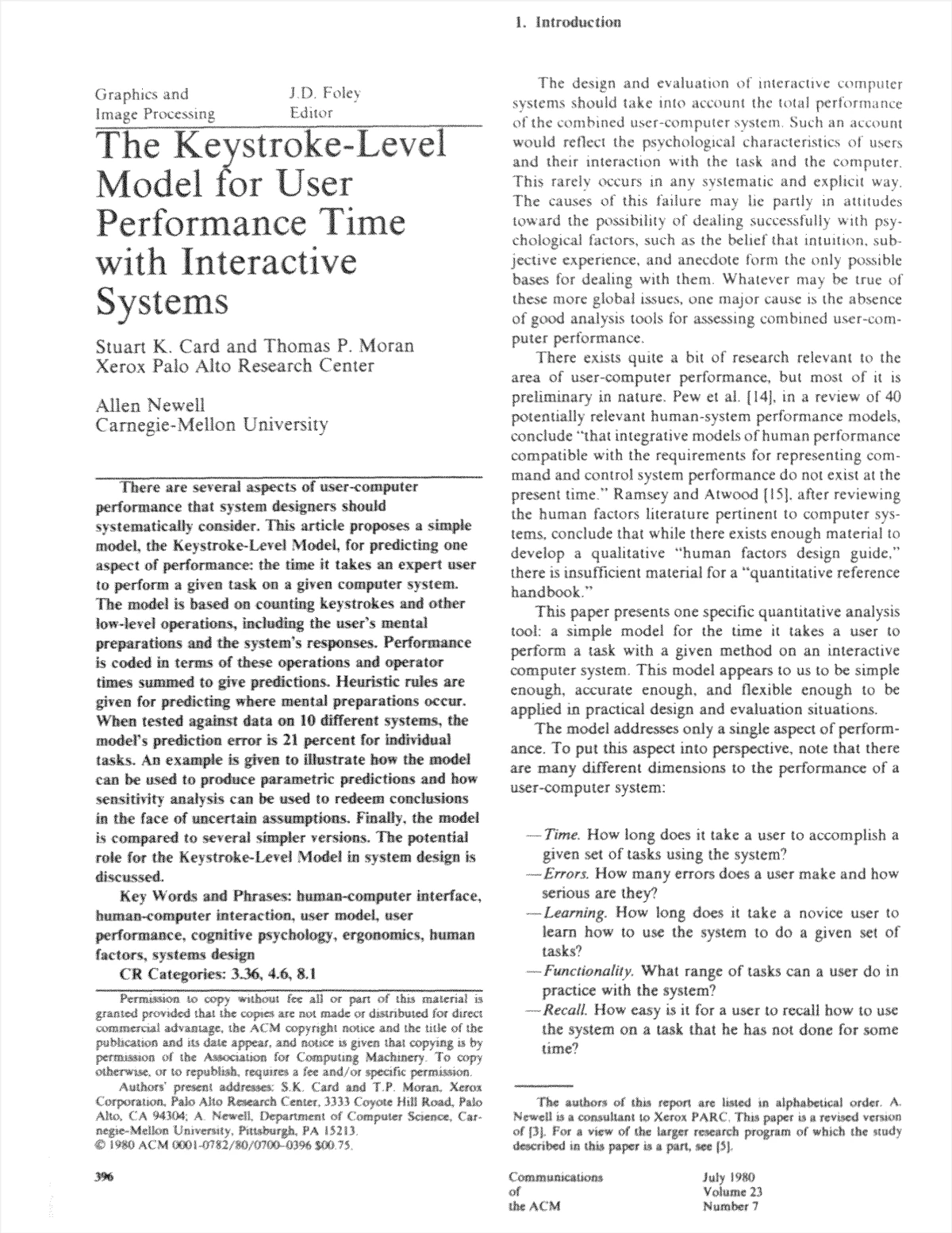
The Keystroke-Level Model for User Performance Time With Interactive Systems
Stuart K. Card, Thomas P. Moran, Allen Newell · 01/07/1980
The 1980 paper presents the Keystroke-Level Model (KLM), a foundational concept that revolutionized the HCI field by quantifying user interaction costs. The KLM provides a means to analyze, compare, and predict the efficiency of interface designs, laying the groundwork for systematic HCI evaluation.
- KLM Metrics: The authors introduce a set of metrics to evaluate user performance in terms of time taken for a set of fundamental actions (keystrokes, mouse movements, etc.), making HCI a more measurable discipline.
- Predictive Modeling: KLM serves as a predictive model that designers can use to anticipate how alternative designs will affect user performance, thereby informing the design process early on.
- Operator Granularity: The paper introduces the notion of breaking down tasks into atomic 'operators', providing a structured way to evaluate complex tasks and their associated time costs.
- Comparison Baseline: KLM has been widely adopted as a baseline for comparing the efficiency of different user interfaces, whether traditional WIMP (Windows, Icons, Menus, Pointer) interfaces or more modern paradigms.
Impact and Limitations: The KLM has had a lasting impact on HCI, influencing both academic research and practical design methodologies. However, it does have limitations, such as not accounting for learning curves, errors, or subjective experiences like satisfaction, requiring complementary evaluation methods for a holistic view.
Read more
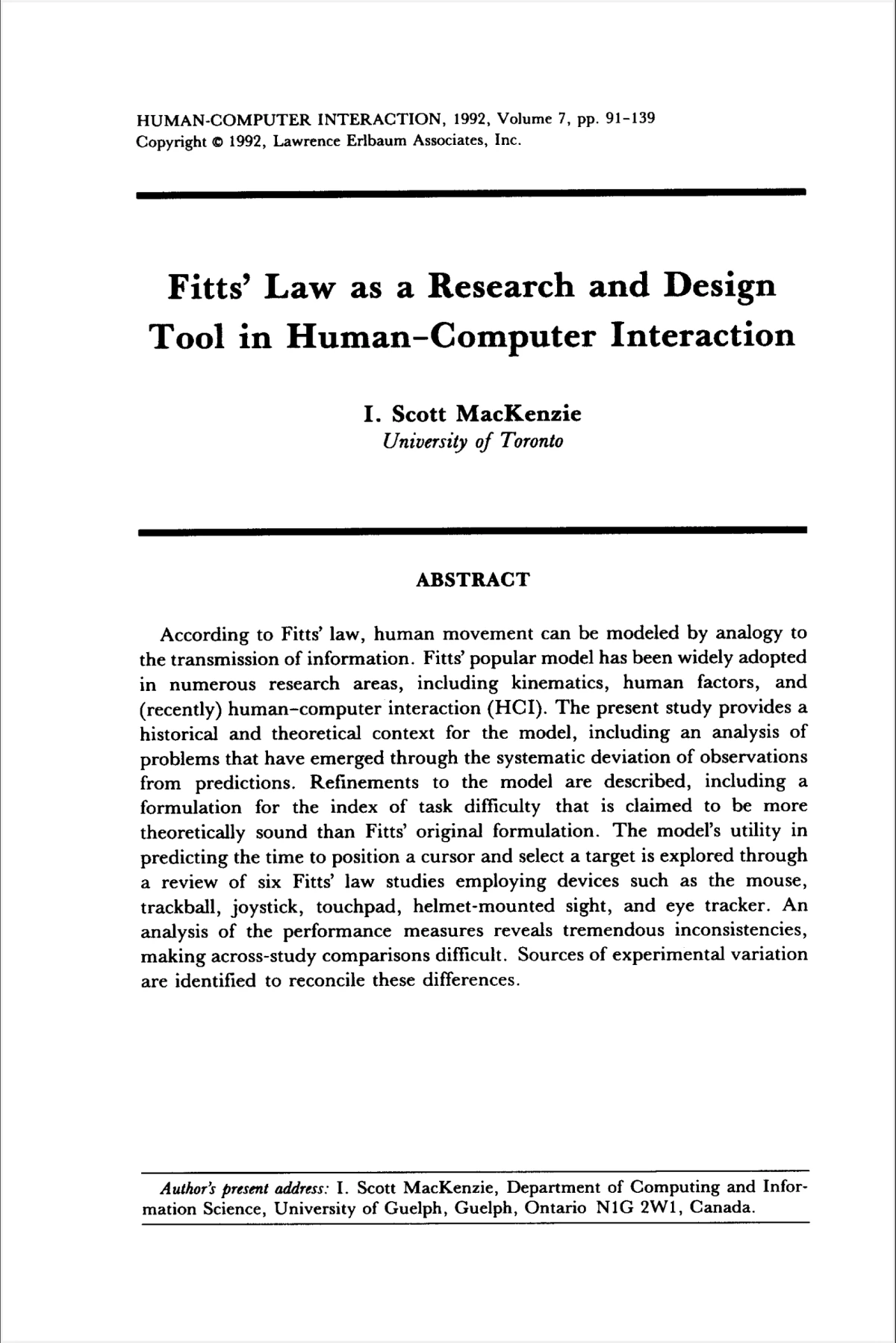
Fitts’ Law as a Research and Design Tool in Human-Computer Interaction
I. Scott MacKenzie · 1992
The 1992 paper by I. Scott MacKenzie elevates Fitts' Law from the realm of psychology and human motor control to a pivotal framework in Human-Computer Interaction (HCI). The paper empirically validates the applicability of Fitts' Law to HCI and offers guidelines for its implementation in interface design.
- Fitts' Law in HCI: MacKenzie’s adaptation of Fitts' Law provides HCI researchers and practitioners with a mathematical model to predict and analyze human movement times in interaction with GUIs, especially for pointing tasks.
- Empirical Validation: The paper supports its arguments through empirical studies, demonstrating the model's ability to predict performance metrics like speed and accuracy in user interactions.
- Design Applications: The paper goes beyond theory to illustrate practical applications, advising on optimal button sizes and placement to improve user experience and efficiency.
- Evaluation Methodology: MacKenzie introduces methodologies for utilizing Fitts’ Law in HCI research, such as task paradigms for measuring performance, which have since been widely adopted.
Impact and Limitations: The paper has had a broad and lasting impact on HCI, offering a quantifiable method to improve interface design. However, the law's applicability may be limited in scenarios involving more complex cognitive processes or multi-modal interactions, calling for extended models or alternative theories.
Read more
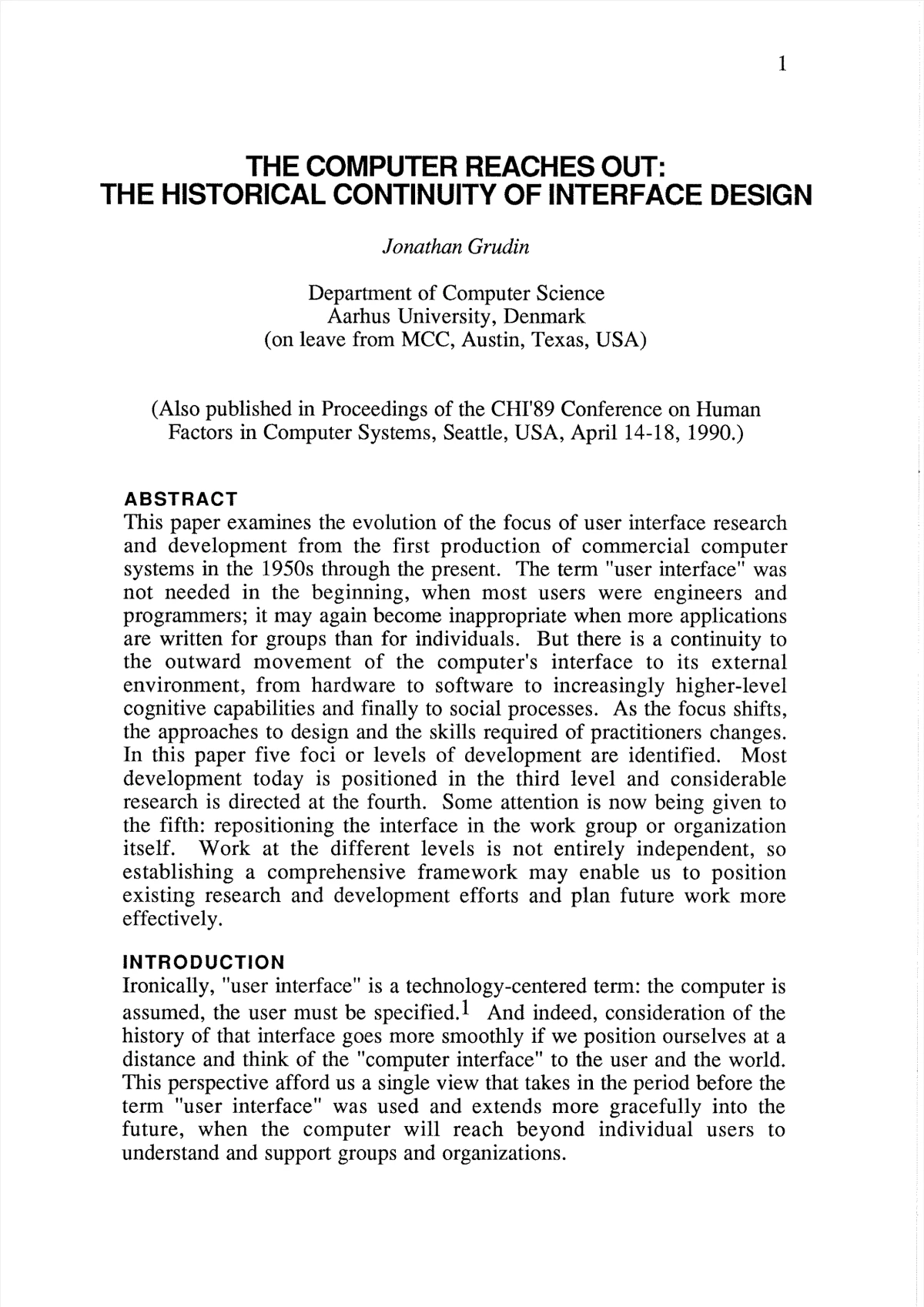
The Computer Reaches Out: The Historical Continuity of User Interface Design
Jonathan Grudin · 01/12/1989
Grudin’s paper is a seminal work that charts the evolution of User Interface (UI) design in the field of Human-Computer Interaction (HCI). It underscores the importance of historical context in shaping UI design.
- Historical Continuity: The paper stresses that understanding prior technology and social contexts can influence future HCI and UI developments, avoiding repeating past failures or overlooking successes.
- User Interface Design: Grudin discusses the drastic shifts in UI design with the computer's changing context, including the shift from business to personal use, highlighting the constant user-adaptation process.
- Iterative Design: Grudin emphasizes that UI design is iterative, not linear, with each phase of technology influencing and informing subsequent stages.
Impact and Limitations: Grudin's chronicle has greatly influenced HCI and UI design, emphasizing the value of historical continuity for future progress. His emphasis on iterative design also highlights the indispensable role of user feedback in UI evolution. However, the paper could give more consideration to the influences of non-western contexts on UI design and the era’s accessibility challenges, offering opportunities for further research and application.
Read more